
Character comparison guide
Ghost Rider vs Spawn: Powers, Feats, and Who Wins?
Ghost Rider vs Spawn is a comparison between two supernatural antiheroes, not an official Marvel/Image Comics crossover. The fairest answer depends on which Ghost Rider, which Spawn era, and whether the fight is judged by comics feats or by an adaptation.
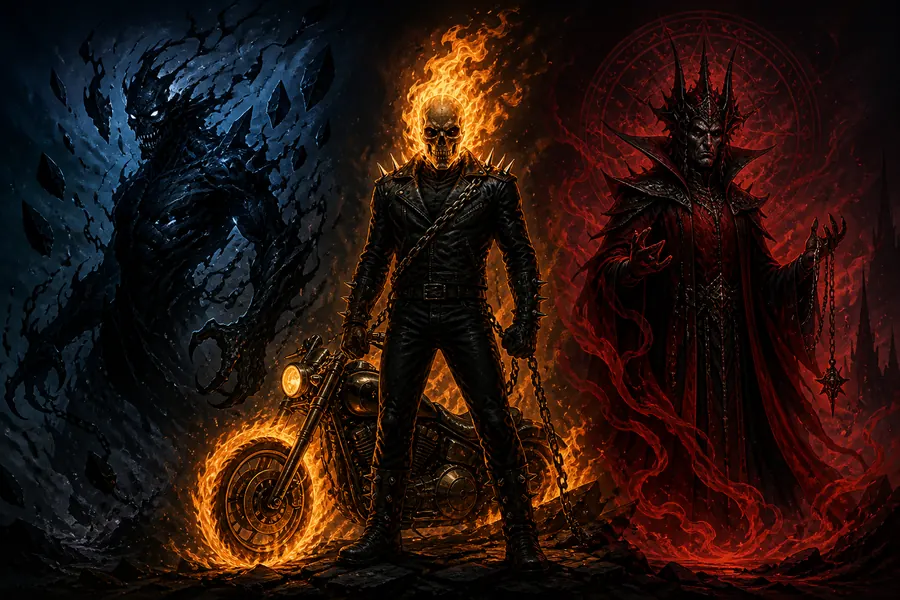
Who would win: Ghost Rider or Spawn?
There is no single canon winner. In a neutral comics comparison, a high-end Spawn has the broader reality-bending toolkit, while a fully empowered Ghost Rider has the cleaner supernatural win condition through hellfire, soul-targeting attacks, and the Penance Stare. If both characters are limited to their familiar baseline versions, Spawn usually has more ways to control the battlefield; Ghost Rider becomes the favorite when the fight gives his Spirit of Vengeance a clear moral target and the Stare can land.
That verdict is a framework rather than a fictional event. Marvel and Image Comics have not published a standard Ghost Rider versus Spawn crossover that settles the question. The Death Battle discussion that drives many searches is a fan-made matchup, so its result can be analyzed as an interpretation without being treated as canon.
Set the versions before comparing the characters
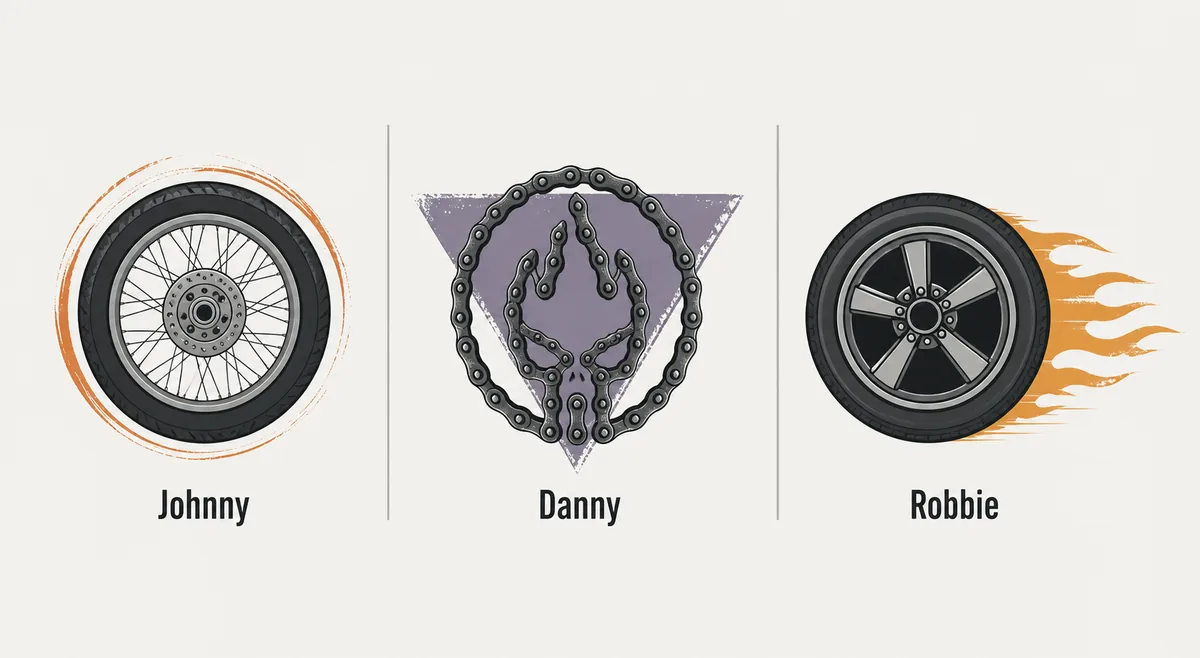
The phrase Ghost Rider can mean Johnny Blaze, Danny Ketch, Robbie Reyes, Cosmic Ghost Rider, or another host. Spawn can mean Al Simmons in an early street-level phase, a later version with larger necroplasm reserves, or a composite interpretation that combines separate eras. Putting the most powerful version of one character against the most familiar version of the other produces a dramatic answer but a weak comparison.
For a useful baseline, compare Johnny Blaze as the classic Spirit of Vengeance with Al Simmons as the main Spawn identity. Then explain how the result changes when the rules change. The site's Johnny Blaze guide and host overview cover the Ghost Rider side in more detail; this page keeps the matchup boundary visible so those pages do not get rewritten into a versus list.
| Comparison rule | Ghost Rider baseline | Spawn baseline | Why it matters |
|---|---|---|---|
| Identity | Johnny Blaze and the Spirit of Vengeance | Al Simmons and his necroplasm suit | Avoids mixing a host list with a single fighter. |
| Source material | Marvel comics continuity | Image Comics continuity | Separate publishers use different supernatural rules. |
| Power ceiling | Classic baseline unless a higher state is named | Mainline baseline unless a later transformation is named | A stated ceiling prevents an accidental composite battle. |
| Victory condition | Incapacitation, exorcism, or a successful soul-based attack | Incapacitation, binding, banishment, or exhausting the suit | A knockout is not the only possible ending. |
Ghost Rider's powers and win conditions
Ghost Rider brings a supernatural body that is difficult to injure with ordinary force. Hellfire can burn beyond a normal physical wound, the chain gives Johnny reach and control, and the Hellcycle makes pursuit or escape part of the fight. The Ghost Rider powers guide explains why these abilities vary by host and story instead of treating every panel as one permanent power scale.
The Penance Stare is the most important matchup question. In stories where the target has committed serious harm and the Stare connects, it can force the victim to experience the pain they caused. But comics do not use it as an automatic button: the target's state, the host's intent, resistance, panel context, and the writer's rules all matter. A comparison that says Ghost Rider wins instantly because the Stare exists skips the actual condition that makes the attack meaningful.
Ghost Rider also has a strong endurance case. Destroying a human host is not always the same as ending the supernatural entity, and the Spirit of Vengeance can return through a different host or state. That does not make Johnny invulnerable. It means a fair answer should specify whether the battle ends when Al or Johnny is down, when the supernatural force is banished, or only when the opponent can no longer continue.
Ghost Rider advantages
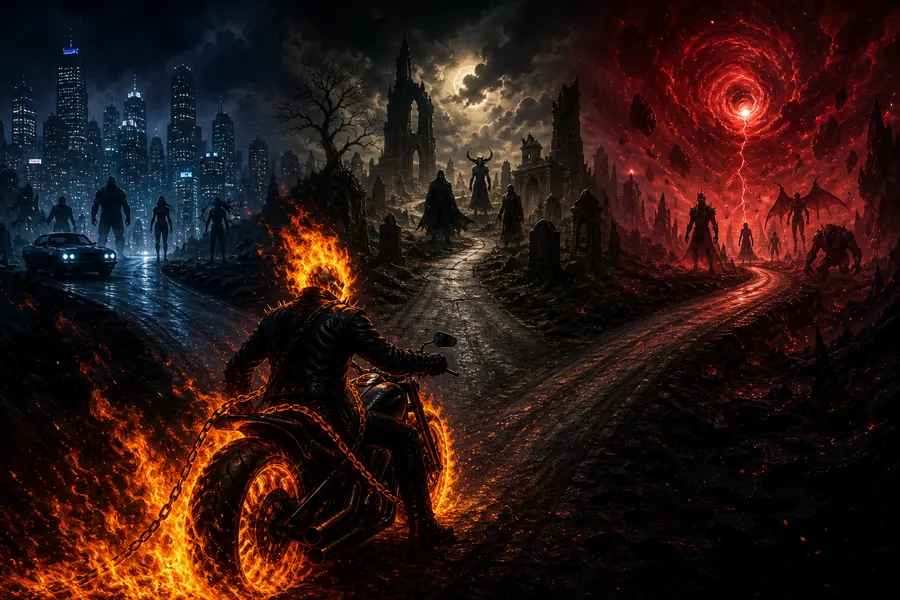
Soul and guilt-based attacks can bypass a simple durability contest.
Hellfire and the chain create both ranged pressure and control.
The Spirit of Vengeance can remain relevant after ordinary physical damage.
Ghost Rider limits
The Penance Stare is conditional and continuity-sensitive.
A host can be separated from the spirit or caught by a binding rule.
Cosmic or alternate Ghost Riders should not be smuggled into a Johnny Blaze baseline.
Spawn's powers and win conditions
Spawn fights with necroplasm, a living suit, supernatural weapons, teleportation, regeneration, and a cape that can act as both armor and restraint. His strength is not just a higher punch. The suit can reshape around damage, conceal movement, and give Al options that a straightforward brawl does not. Spawn's military experience also matters when the scenario allows planning rather than a surprise encounter.
His limits are equally important. Necroplasm is a resource, and a version of Spawn can become less effective when that reserve is depleted or when a story imposes a time, magical, or moral constraint. Spawn's broadest feats often come from later or exceptional states. They are valid evidence only when the article names the era and accepts the same high-end standard for Ghost Rider.
Spawn can win a baseline encounter by controlling distance, binding the rider, or forcing Johnny to spend energy before the Penance Stare is set up. A larger battlefield makes teleportation and the cape more useful. A confined ritual space or a fight built around judgment makes Ghost Rider's supernatural conditions more relevant.
| Category | Ghost Rider | Spawn | Reading of the matchup |
|---|---|---|---|
| Mobility | Hellcycle, chain movement, supernatural travel in some stories | Teleportation, cape movement, and battlefield repositioning | Spawn has more flexible positioning; Ghost Rider has stronger pursuit imagery. |
| Damage | Hellfire, chain, strength, and possible soul-targeting effects | Necroplasm weapons, suit attacks, and transformations | Durability alone cannot decide a soul or magic interaction. |
| Defense | Supernatural endurance and resistance to ordinary attacks | Suit regeneration, armor, healing, and resource limits | Both need a stated rule for what counts as a finishing blow. |
| Battlefield control | Chain, hellfire zones, and fear or judgment pressure | Cape, teleportation, constructs, and restraints | Spawn usually has the wider toolbox in a neutral arena. |
Penance Stare versus necroplasm: the real debate
Most Ghost Rider versus Spawn arguments collapse two different questions into one: can Ghost Rider's signature attack reach Al, and can Al's suit keep him functioning if it does? There is no publisher rulebook that answers the crossover interaction. A careful guide can still identify the conditions. Ghost Rider needs a clear line of effect, a target the Stare can judge, and a version of the attack that affects the opponent's soul or consciousness. Spawn needs either resistance, interruption, a way to avoid eye contact, or a battle plan that ends the encounter first.
The moral framing is also not a shortcut. Al Simmons has committed violence and carries guilt, but the exact meaning of that guilt changes across stories. Ghost Rider's judgment is not identical to a neutral power-level scan. If the matchup says the Stare works on every guilty character, it has already chosen a rule that favors Ghost Rider. If it says the suit blocks every soul effect, it has made the opposite choice. State the rule, then score the fight under that rule.
The practical verdict is therefore conditional: Spawn has the more versatile baseline combat kit, while Ghost Rider has the more decisive single interaction if the Stare and hellfire are allowed to reach the target under their strongest ordinary conditions. A page that presents that distinction is more useful than a one-line winner label.
- Name the host, era, and publisher continuity for both characters.
- Decide whether the fight allows preparation, a neutral arena, or a supernatural judgment setting.
- Define what counts as a win: knockout, death, banishment, restraint, or resource exhaustion.
- Test the Penance Stare and necroplasm interaction separately from strength and speed.
- Report a winner only after the rules are visible, and label any alternate outcome as a scenario rather than canon.
What the Death Battle context can and cannot prove
Searches for Spawn vs Ghost Rider often point to a fan-made Death Battle matchup or discussion video. That material explains why the query is popular and can be useful entertainment context, but it is not a Marvel/Image Comics issue. The result reflects the show's chosen research, assumptions, and presentation. It cannot prove that one publisher's character is canonically stronger in the other's universe.
Use the video context as a separate layer: first give the comics-based comparison, then explain the adaptation or fan-battle conclusion. This keeps the page useful for readers who want the episode while protecting the factual sections from a result that was never published as a crossover. The same rule applies to forum polls, reaction threads, and wiki power rankings.
Scenario verdicts instead of one misleading score
A street-level ambush gives Spawn room to teleport, use the cape, and force Johnny to react. A prepared ritual confrontation gives Ghost Rider more time to establish judgment and hellfire conditions. A cosmic or composite rule set can make either character look unrecognizable, so those versions should be treated as a separate thought experiment rather than the default answer.
The most defensible summary is that Spawn wins more neutral baseline scenarios because his toolkit covers movement, restraint, ranged offense, and recovery. Ghost Rider wins or stalemates scenarios where the Spirit of Vengeance can apply its soul-based judgment and the fight has a meaningful moral or supernatural target. Neither result is a published crossover fact.
| Scenario | Likely edge | Reason | Confidence |
|---|---|---|---|
| Surprise street fight, baseline versions | Spawn | Teleportation, cape control, and flexible range create more early options. | Moderate |
| Judgment-focused supernatural arena | Ghost Rider | The Penance Stare and hellfire receive their clearest conditions. | Low to moderate |
| No-limits composite versions | Undecidable | Combining separate eras removes the shared rules needed for a fair answer. | Low |
| Fan-made Death Battle rules | Use the episode's result as context only | The production's assumptions are not a Marvel/Image canon ruling. | High for context, not canon |
How to keep the comparison accurate
When a new comic or adaptation changes either character, update the version line before rewriting the verdict. Do not copy a feat from Cosmic Ghost Rider into a Johnny Blaze comparison, and do not use a later Spawn transformation to describe every appearance of Al Simmons. The Ghost Rider villains guide and comics reading order can supply continuity context without turning this page into a general character index.
Also separate facts from interpretation. A named power or published appearance is a fact; saying it wins a crossover is an inference. Marking that difference makes the page easier to update and helps readers decide whether they want a comics answer, a fan-battle explanation, or a simple entertaining matchup.
Ghost Rider vs Spawn FAQ
Is Ghost Rider vs Spawn an official crossover?
No. Marvel and Image Comics have not published a standard Ghost Rider versus Spawn crossover that establishes a canon winner. The matchup is a fan comparison built from separate continuities.
Who wins Ghost Rider vs Spawn in a neutral fight?
Spawn has the broader baseline toolkit for a neutral arena, especially through teleportation, the living suit, restraints, and ranged options. Ghost Rider can take the edge when the Penance Stare and hellfire are allowed to work under clear supernatural conditions.
Can Ghost Rider's Penance Stare affect Spawn?
There is no crossover rule that answers this definitively. Treat it as a scenario question: the Stare needs to connect and operate on Al's version of the soul or consciousness, while Spawn may avoid, interrupt, resist, or outlast the effect depending on the story rules.
Is Spawn stronger than Ghost Rider?
Not in every category. Spawn generally has more flexible battlefield control and resource-based abilities, while Ghost Rider has unusual endurance and soul-targeting tools. Version, era, and win condition matter more than a single strength ranking.
Was the Ghost Rider vs Spawn Death Battle result canon?
No. A Death Battle episode or fan video can be discussed as entertainment context, but its research choices and result do not change Marvel or Image Comics continuity.
Which versions should be compared first?
Start with classic Johnny Blaze as Ghost Rider and Al Simmons as the main Spawn identity. Name a later transformation or Cosmic Ghost Rider only when you are intentionally changing the rules.
Who has more comic appearances, Johnny Blaze Ghost Rider or Spawn?
A reliable answer needs a defined counting method because team books, cameos, reprints, and alternate versions are counted differently. Treat it as a separate bibliography question rather than using an unverified number to decide the fight.
Sources and comparison limits
Official character pages provide continuity context. The matchup verdict is an editorial comparison, not a publisher ruling, and fan-made battle videos are labeled as context rather than canon.